A Book Of Nonsense (1846)
A Book Of Nonsense is a book by the English author and illustrator Edward Lear (1812–1888). It is a collection of limericks. Each limerick has an accompanying illustration. Both the limericks and the illustrations were created by Lear.
A Book Of Nonsense was first published in 1846. New and expanded editions appeared in 1855 and 1861, although several of the limericks from the first edition did not appear in subsequent editions.
The 1894 Boston edition of A Book Of Nonsense is reproduced below, with two changes:
- Firstly, the “By way of preface” appeared in the 1887 edition published by Frederick Warne and Co. Ltd. in London and New York.
- Secondly, the last four limericks below did not appear in the text of the 1894 Boston edition, though the very last one below did appear on its title page. The last four limericks below appeared in the text or front matter of the original 1846 London edition; in fact, all of the limericks and accompanying illustrations that appeared in at least one edition of A Book Of Nonsense are included below.
Contents
Title Page From 1894 Boston Edition
Title Page From 1894 Boston Edition
A Book Of Nonsense
By Edward Lear.
With All the Original Pictures and Verses

Who loved to see little folks merry;
So he made them a book,
And with laughter they shook
At the fun of that Derry down Derry.
Boston:
Roberts Brothers.
1894.
Originally published 1846.
Original Dedication
By Way Of Preface
It is believed that all save the youngest readers of these Nonsense Books will be interested in the two following autobiographical letters by the author, which have never till now been published. The first, written nearly a quarter of a century back, just before one of his journeys in search of the picturesque, is a strict recital of date and fact; the second, composed some years later, and after he had set up his residence at San Remo, was written for a young lady of his acquaintance, who had quoted to him the words of a young lady not of his acquaintance, which form the refrain of the verses—”How pleasant to know Mr. Lear!”
My Dear F.,
I want to send you, before leaving England, a note or two as to the various publications I have uttered,—bad and good, and of all sorts,—also their dates, that so you might be able to screw them into a beautiful memoir of me in case I leave my bones at Palmyra or elsewhere. Leastwise, if a man does anything all through life with a deal of bother, and likewise of some benefit to others, the details of such bother and benefit may as well be known accurately as the contrary.
Born in 1812 (12th May), I began to draw, for bread and cheese, about 1827, but only did uncommon queer shop-sketches—selling them for prices varying from ninepence to four shillings: colouring prints, screens, fans; awhile making morbid disease drawings for hospitals and certain doctors of physic. In 1831, through Mrs. Wentworth, I became employed at the Zoological Society, and, in 1832, published “The Family of the Psittacidæ,” the first complete volume of coloured drawings of birds on so large a scale published in England, as far as I know—unless Audubon’s were previously engraved. J. Gould’s “Indian Pheasants” were commenced at the same time, and after a little while he employed me to draw many of his birds of Europe, while I assisted Mrs. Gould in all her drawings of foregrounds, as may be seen in a moment by any one who will glance at my drawings in G.’s European birds and the Toucans. From 1832 to 1836, when my health failed a good deal, I drew much at the Earl of Derby’s; and a series of my drawings was published by Dr. Gray of the British Museum—a book now rare. I also lithographed many various detached subjects, and a large series of Testudinata for Mr. (now Professor) Bell; and I made drawings for Bell’s “British Mammalia,” and for two or more volumes of the “Naturalist’s Library” for the editor. Sir W. Jardine, those volumes being the Parrots, and, I think, the Monkeys, and some Cats. In 1835 or ’36, being in Ireland and the Lakes, I leaned more and more to landscape, and when in 1837 it was found that my health was more affected by the climate month by month, I went abroad, wintering in Rome till 1841, when I came to England and published a volume of lithographs called “Rome and its Environs.” Returning to Rome, I visited Sicily and much of the South of Italy, and continued to make chalk drawings, though in 1840 I had painted my two first oil-paintings. I also gave lessons in drawing at Rome, and was able to make a very comfortable living. In 1845 I came again to England, and in 1846 gave Queen Victoria some lessons, through Her Majesty’s having seen a work I published in that year on the Abruzzi, and another on the Roman States. In 1847 I went through all Southern Calabria, and again went round Sicily, and in 1848 left Rome entirely. I travelled then to Malta, Greece, Constantinople, and the Ionian Islands; and to Mount Sinai and Greece a second time in 1849, returning to England in that year. All 1850 I gave up to improving myself in figure-drawing, and I continued to paint oil-paintings till 1853, having published in the meantime, in 1849 and 1852, two volumes entitled “Journals of a Landscape Painter,” in Albania and Calabria. The first edition of the “Book of Nonsense” was published in 1846, lithographed by tracing-paper. In 1854 I went to Egypt and Switzerland, and in 1855 to Corfu, where I remained the winters of 1856-57-58, visiting Athos, and, later, Jerusalem and Syria. In the autumn of 1858 I returned to England, and ’59 and ’60 winters’ were passed in Rome. 1861, I remained all the winter in England, and painted the Cedars of Lebanon and Masada, going, after my sister’s death in March 1861, to Italy. The two following winters—’62 and ’63—were passed at Corfu, and in the end of the latter year I published “Views in the Ionian Islands.” In 1862 a second edition of the “Book of Nonsense,” much enlarged, was published, and is now in its sixteenth thousand.
O bother!
Yours affectionately,
EDWARD LEAR
Self-portrait of the Laureate of Nonsense
Who has written such volumes of stuff!
Some think him ill-tempered and queer,
But a few think him pleasant enough.
His mind is concrete and fastidious,
His nose is remarkably big;
His visage is more or less hideous,
His beard it resembles a wig.
He has ears, and two eyes, and ten fingers,
Leastways if you reckon two thumbs;
Long ago he was one of the singers,
But now he is one of the dumbs.
He sits in a beautiful parlour.
With hundreds of books on the wall;
He drinks a great deal of Marsala,
But never gets tipsy at all.
He has many friends, laymen and clerical,
Old Foss is the name of his cat:
His body is perfectly spherical,
He weareth a runcible hat.
When he walks in a waterproof white,
The children run after him so!
Calling out, “He’s come out in his night-
gown, that crazy old Englishman, oh!”
He weeps by the side of the ocean,
He weeps on the top of the hill;
He purchases pancakes and lotion,
And chocolate shrimps from the mill.
He reads but he cannot speak Spanish,
He cannot abide ginger-beer:
Ere the days of his pilgrimage vanish,
How pleasant to know Mr. Lear!
Nonsense Pictures And Rhymes

Who said, “If you choose to suppose
That my nose is too long,
You are certainly wrong!”
That remarkable Man with a nose.
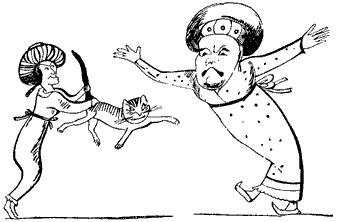
Whose Grandmother threatened to burn her;
But she seized on the Cat,
And said, “Granny, burn that!
You incongruous Old Woman of Smyrna!”
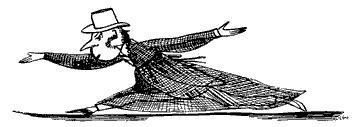
Who seldom, if ever, stood still;
He ran up and down
In his Grandmother’s gown,
Which adorned that Old Man on a hill.
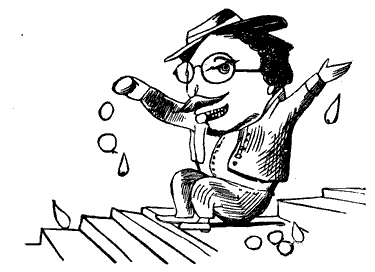
Whose conduct was painful and silly;
He sate on the stairs,
Eating apples and pears,
That imprudent Old Person of Chili.
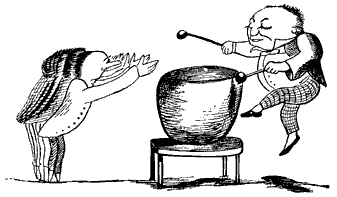
Who bumped at it all the day long;
But they called out, “Oh, law!
You’re a horrid old bore!”
So they smashed that Old Man with a gong.
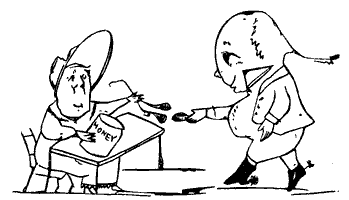
Who never had more than a penny;
He spent all that money
In onions and honey,
That wayward Old Man of Kilkenny.
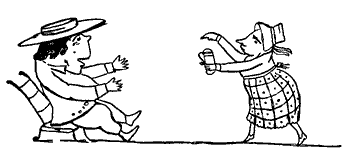
Who was thirsty, and called out for some beer;
But they brought it quite hot,
In a small copper pot,
Which disgusted that man of Columbia.

Who was horribly bored by a Bee;
When they said, “Does it buzz?”
He replied, “Yes, it does!
It’s a regular brute of a Bee.”
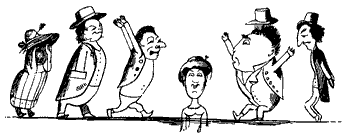
Who made a remarkable curtsey;
She twirled round and round,
Till she sank underground,
Which distressed all the people of Chertsey.

Resembled the point of a pin;
So she had it made sharp,
And purchased a harp,
And played several tunes with her chin.
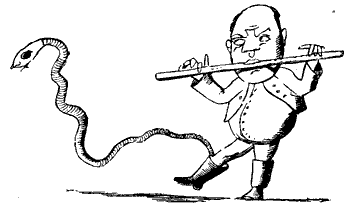
A “sarpint” ran into his boot!
But he played day and night,
Till the “sarpint” took flight,
And avoided that Man with a flute.
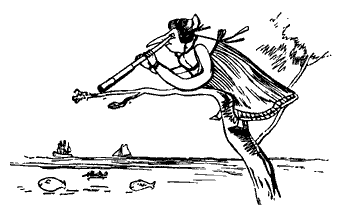
Whose ideas were excessively nautical;
She climbed up a tree
To examine the sea,
But declared she would never leave Portugal.
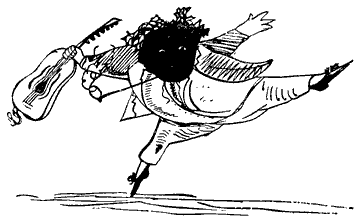
Whose conduct grew friskier and friskier;
He danced hornpipes and jigs,
And ate thousands of figs,
That lively Old Person of Ischia.
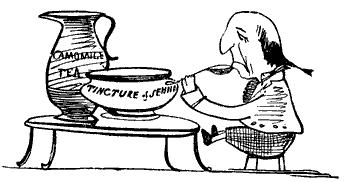
Who lived upon Tincture of Senna;
When that did not agree,
He took Camomile Tea,
That nasty Old Man of Vienna.
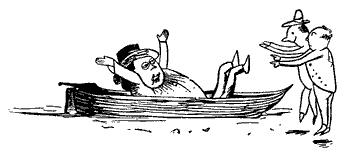
Who said, “I’m afloat! I’m afloat!”
When they said, “No, you ain’t!”
He was ready to faint,
That unhappy Old Man in a boat.
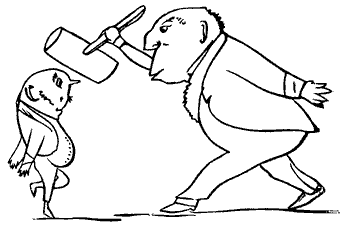
Whose conduct grew ruder and ruder,
Till at last with a hammer
They silenced his clamor.
By smashing that Person of Buda.

Who had the most curious behavior;
For while he was able,
He slept on a table,
That funny Old Man of Moldavia.
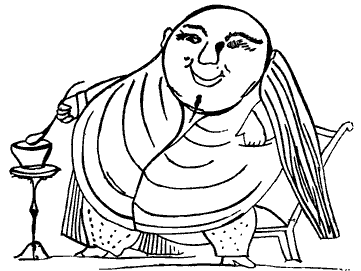
Who drank when he was not athirst;
When they said, “You’ll grow fatter!”
He answered “What matter?”
That globular Person of Hurst.

Who rode on a cream-colored Ass;
But the length of its ears
So promoted his fears,
That it killed that Old Man of Madras.

Who rushed through a field of blue clover;
But some very large Bees
Stung his nose and his knees,
So he very soon went back to Dover.
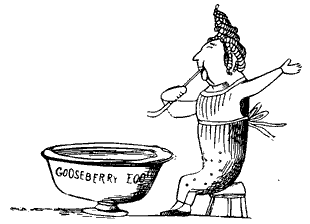
Whose head was infested with beads;
She sat on a stool
And ate gooseberry-fool,
Which agreed with that Person of Leeds.
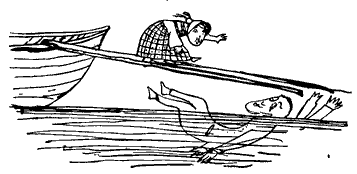
Who was always polite to all ladies;
But in handing his daughter,
He fell into the water,
Which drowned that Old Person of Cadiz.

Whose face was pervaded with smiles;
He sang, “High dum diddle,”
And played on the fiddle,
That amiable Man of the Isles.
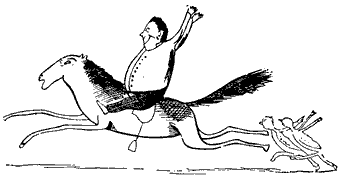
Whose presence of mind was amazing;
He purchased a steed,
Which he rode at full speed,
And escaped from the people of Basing.
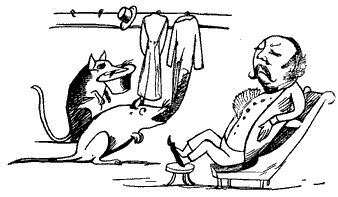
That the street door was partially closed;
But some very large Rats
Ate his coats and his hats,
While that futile Old Gentleman dozed.

Induced him to feed upon Rabbits;
When he’d eaten eighteen,
He turned perfectly green,
Upon which he relinquished those habits.
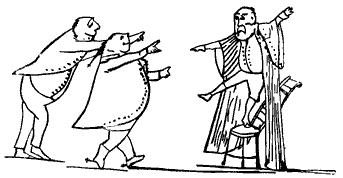
Who wore a pale plum-colored vest;
When they said, “Does it fit?”
He replied, “Not a bit!”
That uneasy Old Man of the West.
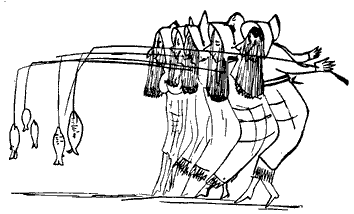
Whose daughters wore bottle-green veils:
They caught several Fish,
Which they put in a dish,
And sent to their Pa at Marseilles.
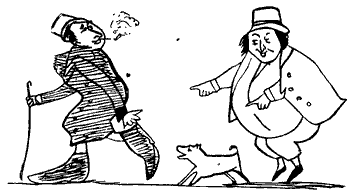
Whose shoes made a horrible creaking;
But they said, “Tell us whether
Your shoes are of leather,
Or of what, you Old Man of the Wrekin?”
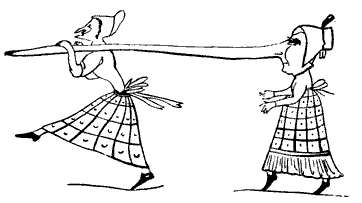
Was so long that it reached to her toes;
So she hired an Old Lady,
Whose conduct was steady,
To carry that wonderful nose.
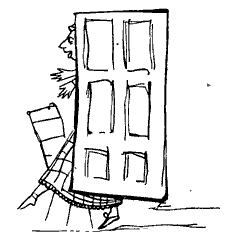
Who casually sat in a doorway;
When the door squeezed her flat,
She exclaimed, “What of that?”
This courageous Young Lady of Norway.

Whose conduct was very peculiar;
He fed twenty sons
Upon nothing but buns,
That whimsical Man of Apulia.

A beetle ran over his neck;
But he cried, “With a needle
I’ll slay you, O beadle!”
That angry Old Man of Quebec.

Who played on a silver-gilt flute;
She played several jigs
To her Uncle’s white Pigs:
That amusing Young Lady of Bute.

Whose conduct was scroobious and wily;
He rushed up a Palm
When the weather was calm,
And observed all the ruins of Philœ.

Who painted his face with red ochre.
When they said, “You’re a Guy!”
He made no reply,
But knocked them all down with his poker.
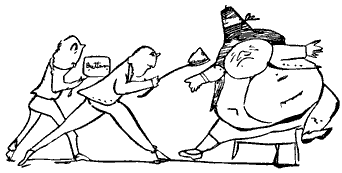
Who was suddenly seized with the plague;
But they gave him some butter,
Which caused him to mutter,
And cured that Old Person of Prague.
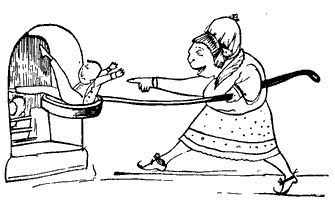
Who watched his wife making a stew;
But once, by mistake,
In a stove she did bake
That unfortunate Man of Peru.
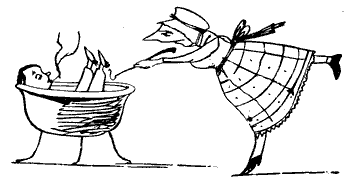
Who fell into a basin of broth;
But a laudable cook
Fished him out with a hook,
Which saved that Old Man of the North.
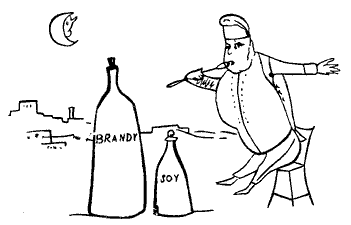
Whose drink was warm brandy and soy,
Which he took with a spoon,
By the light of the moon,
In sight of the city of Troy.
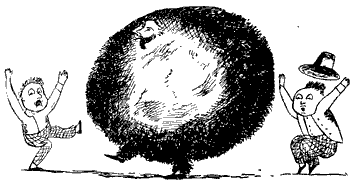
Who shrank from sensations of cold;
So he purchased some muffs,
Some furs, and some fluffs,
And wrapped himself well from the cold.
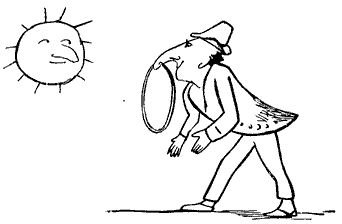
Who embellished his nose with a ring;
He gazed at the moon
Every evening in June,
That ecstatic Old Person of Tring.

From his horse had a terrible fall;
But, though split quite in two,
With some very strong glue
They mended that man of Nepaul.
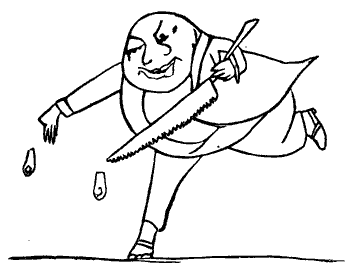
Who sharpened his nails with a file,
Till he cut off his thumbs,
And said calmly, “This comes
Of sharpening one’s nails with a file!”
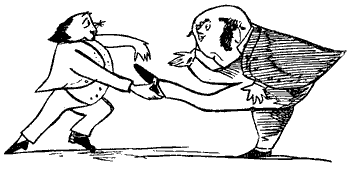
So blind that he couldn’t his foot see;
When they said, “That’s your toe,”
He replied, “Is it so?”
That doubtful Old Man of th’ Abruzzi.

Who perpetually ate bread and butter;
Till a great bit of muffin,
On which he was stuffing,
Choked that horrid Old Man of Calcutta.
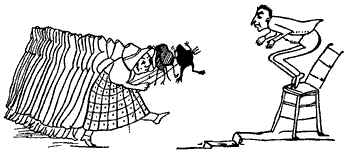
Who strongly objected to toads;
He paid several cousins
To catch them by dozens,
That futile Old Person of Rhodes.

Who had an immoderate mouth;
But in swallowing a dish
That was quite full of Fish,
He was choked, that Old Man of the South.
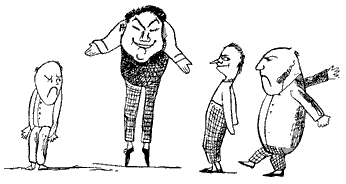
Who walked on the tips of his toes;
But they said, “It ain’t pleasant
To see you at present,
You stupid Old Man of Melrose.”
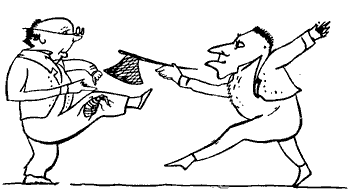
Who was sadly annoyed by a Flea;
When he said, “I will scratch it!”
They gave him a hatchet,
Which grieved that Old Man of the Dee.
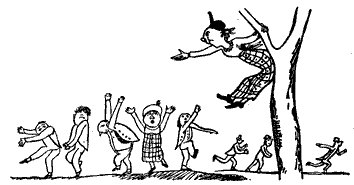
Whose lovers completely forsook her;
She ran up a tree,
And said “Fiddle-de-dee!”
Which embarrassed the people of Lucca.

The length of whose legs was immense;
He went with one prance
From Turkey to France,
That surprising Old Man of Coblenz.

Whose daughter was christened Euphemia;
But one day, to his grief,
She married a thief,
Which grieved that Old Man of Bohemia.

Who never knew what he should do;
So he rushed up and down,
Till the sun made him brown,
That bewildered Old Man of Corfu.

Who studied the works of Vitruvius;
When the flames burnt his book,
To drinking he took,
That morbid Old Man of Vesuvius.
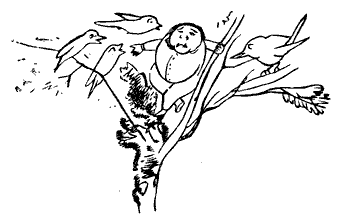
Who frequented the top of a tree;
When disturbed by the Crows,
He abruptly arose,
And exclaimed, “I’ll return to Dundee!”

Induced her to sit in a holly;
Whereon, by a thorn
Her dress being torn,
She quickly became melancholy.

Who shut his Wife up in a box:
When she said, “Let me out,”
He exclaimed, “Without doubt
You will pass all your life in that box.”
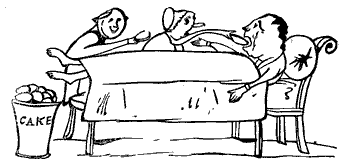
Who was troubled with horrible dreams;
So to keep him awake
They fed him with cake,
Which amused that Old Person of Rheims.
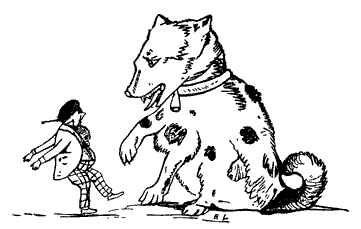
The smallest that ever was born;
But quickly snapt up he
Was once by a Puppy,
Who devoured that Old Man of Leghorn.
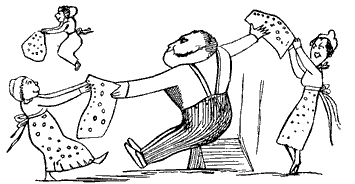
Whose waistcoat was spotted with blue;
But he tore it in pieces,
To give to his Nieces,
That cheerful Old Man in a pew.
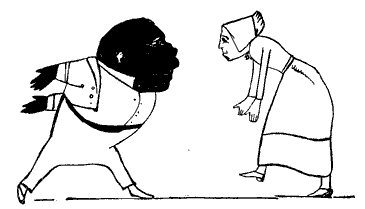
Who suddenly married a Quaker;
But she cried out, “Oh, lack!
I have married a black!”
Which distressed that Old Man of Jamaica.

Shall I flee from this horrible Cow?
I will sit on this stile,
And continue to smile,
Which may soften the heart of that Cow.”
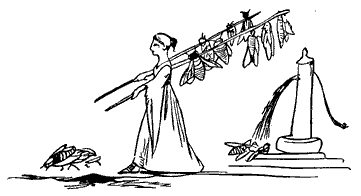
Whom several large flies did annoy;
Some she killed with a thump,
Some she drowned at the pump,
And some she took with her to Troy.

Who was chased by a virulent Bull;
But she seized on a spade,
And called out, “Who’s afraid?”
Which distracted that virulent Bull.

Whose head was as small as a button;
So to make it look big
He purchased a wig,
And rapidly rushed about Dutton.
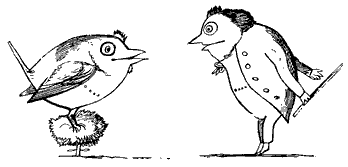
I perceive a young bird in this bush!”
When they said, “Is it small?”
He replied, “Not at all;
It is four times as big as the bush!”

Who screamed so that no one could hush her;
Her screams were extreme,—
No one heard such a scream
As was screamed by that Lady of Russia.
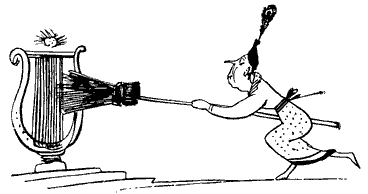
Who swept the loud chords of a lyre;
At the sound of each sweep
She enraptured the deep,
And enchanted the city of Tyre.
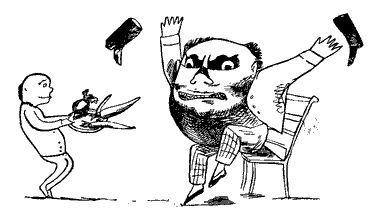
Whose face was distorted with anger;
He tore off his boots,
And subsisted on roots,
That borascible Person of Bangor.
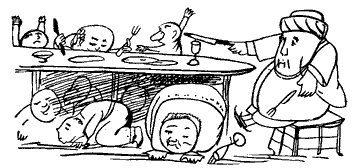
Who gave all his children a feast;
But they all ate so much,
And their conduct was such,
That it killed that Old Man of the East.
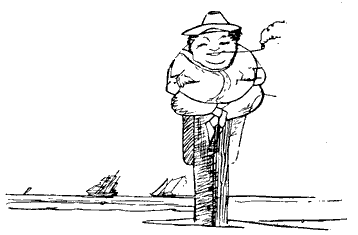
Who placidly sat on a post;
But when it was cold
He relinquished his hold,
And called for some hot buttered toast.
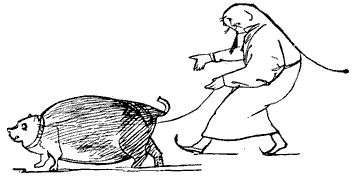
Who possessed a remarkably fat Cur;
His gait and his waddle
Were held as a model
To all the fat dogs in Kamschatka.
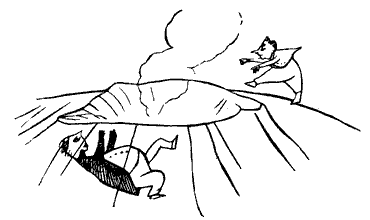
Who rushed down the crater of Etna;
When they said, “Is it hot?”
He replied, “No, it’s not!”
That mendacious Old Person of Gretna.
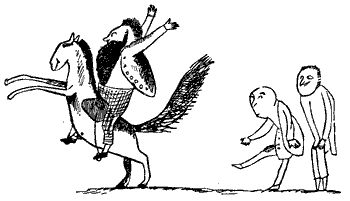
Who sat on a Horse when he reared;
But they said, “Never mind!
You will fall off behind,
You propitious Old Man with a beard!”
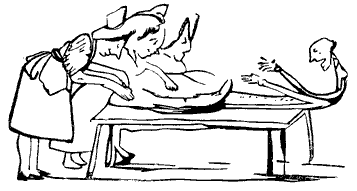
Whose form was uncommonly thin;
Till he once, by mistake,
Was mixed up in a cake,
So they baked that Old Man of Berlin.
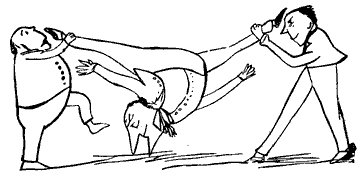
Who never could get any rest;
So they set him to spin
On his nose and his chin,
Which cured that Old Man of the West.
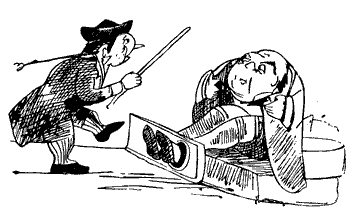
Was put in the stocks by the Beadle
For stealing some pigs,
Some coats, and some wigs,
That horrible person of Cheadle.
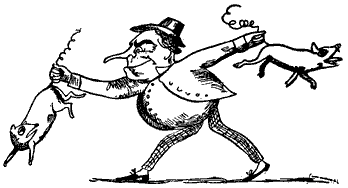
Whose conduct was strange and unmannerly;
He rushed down the Strand
With a Pig in each hand,
But returned in the evening to Anerley.

Who caught a large Fish without scales;
When she lifted her hook,
She exclaimed, “Only look!”
That ecstatic Young Lady of Wales.
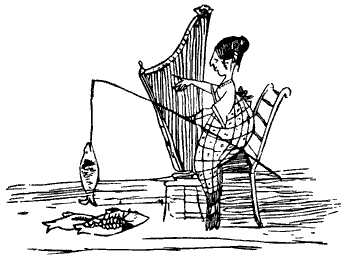
Whose praise all the world was a-telling;
She played on the harp,
And caught several Carp,
That accomplished Young Lady of Welling.
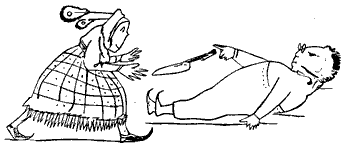
Who divided his jugular artery;
But he screeched to his Wife,
And she said, “Oh, my life!
Your death will be felt by all Tartary!”
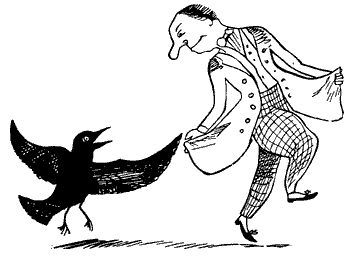
Who danced a quadrille with a Raven;
But they said, “It’s absurd
To encourage this bird!”
So they smashed that Old Man of Whitehaven.
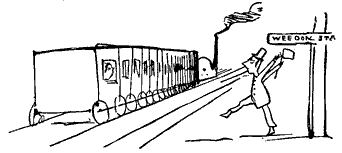
Who went by the slow train to Weedon;
When they cried, “Weedon Station!”
She made no observation,
But thought she should go back to Sweden.

Whom several small children did pester;
They threw some large stones,
Which broke most of his bones,
And displeased that Old Person of Chester.

Who possessed a large Barbary Ape;
Till the Ape, one dark night,
Set the house all alight,
Which burned that Old Man of the Cape.

Whose answers were rather uncertain;
When they said, “How d’ ye do?”
He replied, “Who are you?”
That distressing Old Person of Burton.

Who casually fell in the Thames;
And when he was found,
They said he was drowned,
That unlucky Old Person of Ems.
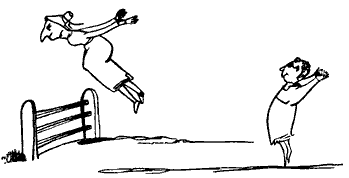
Whose Aunt was a very fast walker;
She walked seventy miles,
And leaped fifteen stiles,
Which astonished that Girl of Majorca.
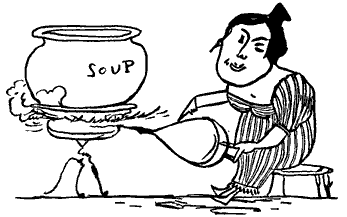
Whose soup was excessively cool;
So she put it to boil
By the aid of some oil,
That ingenious Young Lady of Poole.
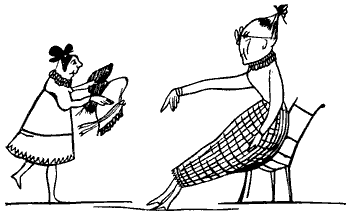
Whose language was horribly vague;
When they said, “Are these caps?”
She answered, “Perhaps!”
That oracular Lady of Prague.
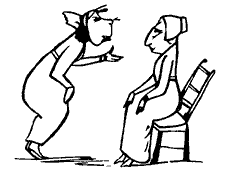
Whose conduct grew calmer and calmer:
When they said, “Are you dumb?”
She merely said, “Hum!”
That provoking Young Lady of Parma.
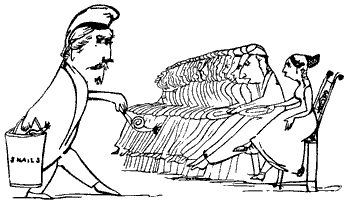
Who had twenty-five sons and one “darter;”
He fed them on Snails,
And weighed them in scales,
That wonderful Person of Sparta.
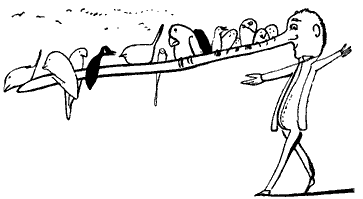
Most birds of the air could repose;
But they all flew away
At the closing of day,
Which relieved that Old Man and his nose.
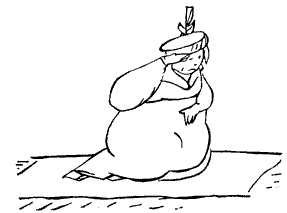
Who wept when the weather was murky;
When the day turned out fine,
She ceased to repine,
That capricious Young Lady of Turkey.
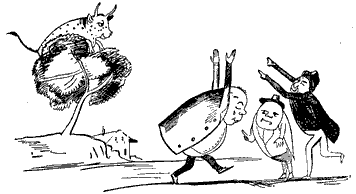
Who possessed a large Cow, but he lost her;
But they said, “Don’t you see
She has run up a tree,
You invidious Old Man of Aôsta?”
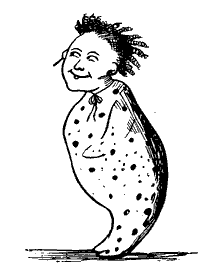
Whose toilette was far from complete;
She dressed in a sack
Spickle-speckled with black,
That ombliferous Person of Crete.

Who was madly pursued by a Bear;
When she found she was tired,
She abruptly expired,
That unfortunate Lady of Clare.

Who bought a large bonnet for walking;
But its color and size
So bedazzled her eyes,
That she very soon went back to Dorking.
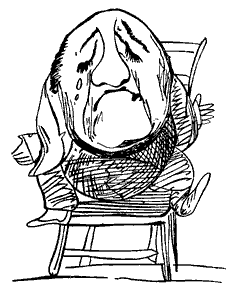
Who wished he had never been born;
So he sat on a Chair
Till he died of despair,
That dolorous Man of Cape Horn.

Who stood on one leg to read Homer;
When he found he grew stiff,
He jumped over the cliff,
Which concluded that Person of Cromer.

Whose ideas were excessively vague;
He built a balloon
To examine the moon,
That deluded Old Man of the Hague.

Who hated all trouble and pain;
So he sate on a chair
With his feet in the air,
That umbrageous Old Person of Spain.

Will nobody answer this bell?
I have pulled day and night,
Till my hair has grown white,
But nobody answers this bell!”

Who continued to bother and howl;
He sat on a rail,
And imbibed bitter ale,
Which refreshed that Old Man and his Owl.

Who held up his hands in amazement;
When they said, “Sir, you’ll fall!”
He replied, “Not at all!”
That incipient Old Man in a casement.
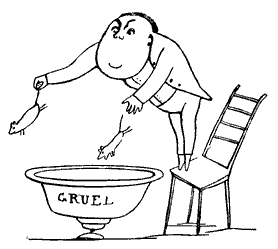
Who chiefly subsisted on gruel;
But to make it more nice,
He inserted some Mice,
Which refreshed that Old Person of Ewell.

Who never knew what he should do;
So he tore off his hair,
And behaved like a bear,
That intrinsic Old Man of Peru.
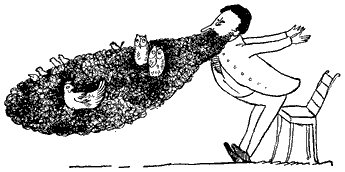
Who said, “It is just as I feared!—
Two Owls and a Hen,
Four Larks and a Wren,
Have all built their nests in my beard.”

Were unique as to color and size;
When she opened them wide,
People all turned aside,
And started away in surprise.

Whose shoe-strings were seldom untied;
She purchased some clogs,
And some small spotty Dogs,
And frequently walked about Ryde.

Came untied when the birds sate upon it;
But she said, “I don’t care!
All the birds in the air
Are welcome to sit on my bonnet!”

Who climbed into a very old chair,
Where he said, “Here I stays,
Till the end of my days!”
That immovable Man of Kildare.

Who murdered himself with a fork;
But nobody cried –
Though he very soon died –
For that silly Old Man of New York.

Whose vessel a rock it once bump’d on;
The shock was so great,
That it damaged the pate,
Of that singular Sailor of Compton.

Who loved to see little folks merry;
So he made them a book,
And with laughter they shook
At the fun of that Derry down Derry.